Indonesia’s Top Export Destinations and Market Opportunities

An overview of Indonesia’s top non-oil export destinations in 2025—from China and the US to high-growth emerging markets in ASEAN, Europe, and the Middle East.
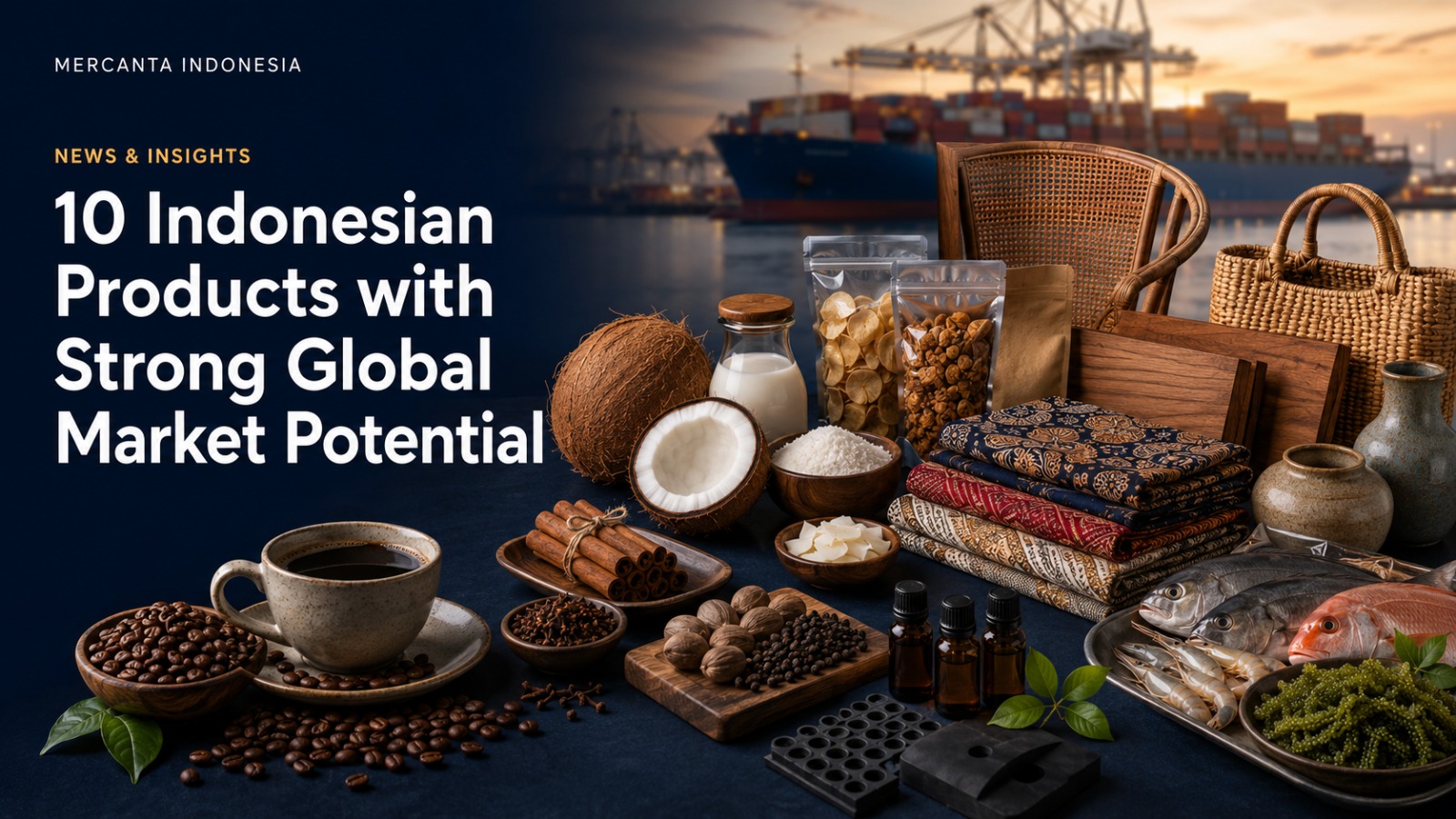
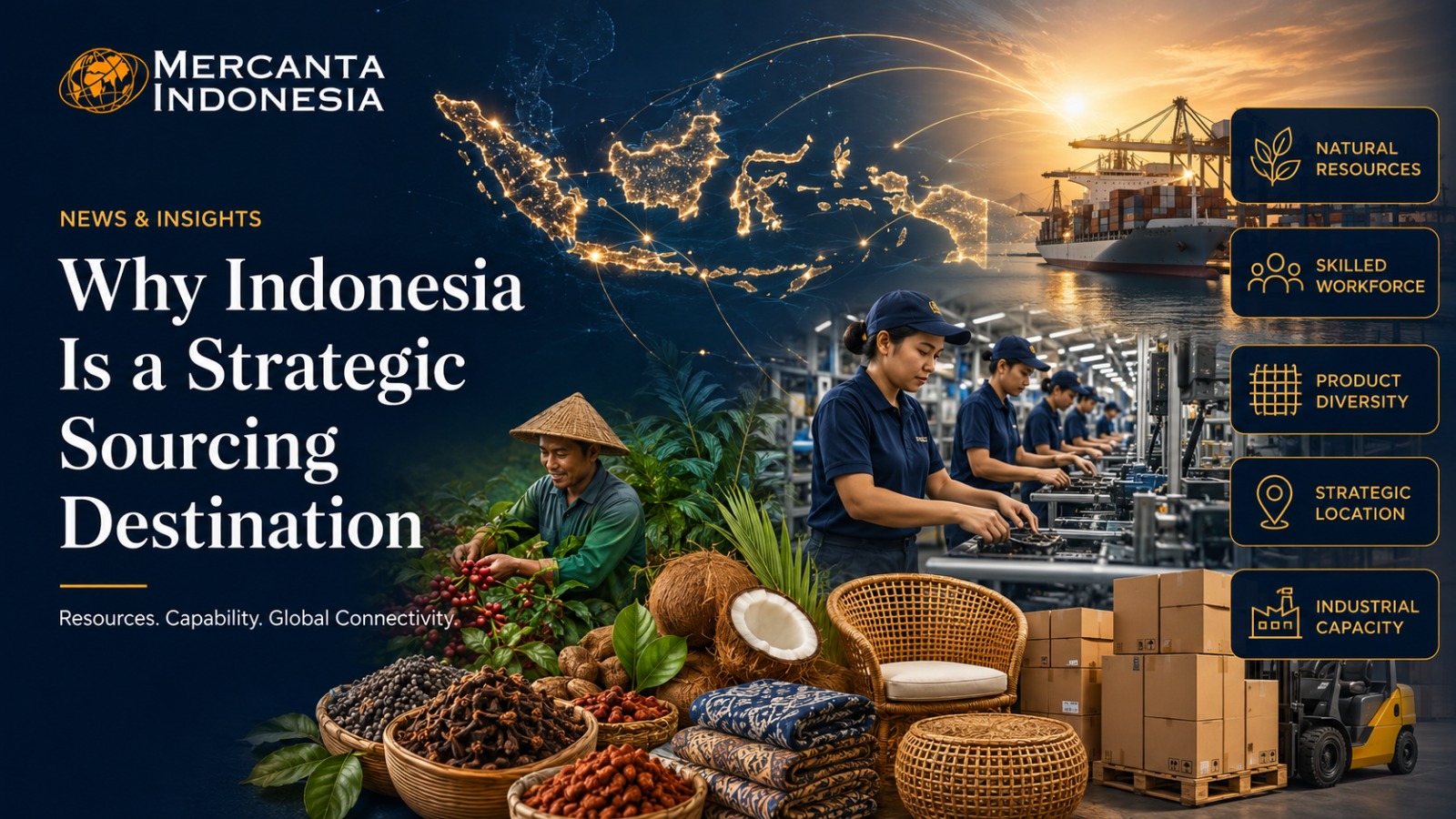
Indonesia is increasingly connected to the global economy through a diverse export portfolio that includes natural resources, manufactured products, agricultural commodities, food and beverages, textiles, footwear, furniture, handicrafts, and value-added industrial goods.
In 2025, Indonesia’s total exports reached approximately US$282.91 billion, representing an increase of 6.15 percent compared with 2024. Non-oil and gas exports contributed approximately US$269.84 billion, while the country recorded a total trade surplus of US$41.05 billion.
China, the United States, and India remained Indonesia’s three largest non-oil and gas export destinations. Together, these markets represented more than 42 percent of Indonesia’s non-oil and gas exports during January–November 2025.
However, Indonesia’s export opportunities extend far beyond its traditional markets. ASEAN, the European Union, the Middle East, Africa, Central Asia, and Latin America offer significant possibilities for Indonesian businesses that can meet international standards and understand local market requirements.
Indonesia’s Leading Export Destinations
According to Indonesia’s Ministry of Trade, the largest destinations for Indonesian non-oil and gas exports in 2025 included:
• Rank 1: China | 2025 Export Value: US$64.75 billion | Share: 24.01% • Rank 2: United States | 2025 Export Value: US$30.95 billion | Share: 11.47% • Rank 3: India | 2025 Export Value: US$18.29 billion | Share: 6.78% • Rank 4: Japan | 2025 Export Value: US$15.52 billion | Share: 5.75% • Rank 5: Malaysia | 2025 Export Value: US$11.70 billion | Share: 4.34% • Rank 6: Vietnam | 2025 Export Value: US$10.62 billion | Share: 3.94% • Rank 7: Philippines | 2025 Export Value: US$10.13 billion | Share: 3.76% • Rank 8: Singapore | 2025 Export Value: US$9.87 billion | Share: 3.66% • Rank 9: South Korea | 2025 Export Value: US$8.96 billion | Share: 3.32%
The figures demonstrate the importance of Asian markets while also showing the strategic role of the United States as Indonesia’s largest non-Asian export destination.
1. China: Indonesia’s Largest Export Market
China remained Indonesia’s largest non-oil and gas export destination in 2025, with exports valued at approximately US$64.75 billion.
Indonesia’s exports to China are strongly supported by industrial commodities, including iron and steel, mineral fuels, nickel, and related products.
Beyond commodities, China presents opportunities for:
• Coffee and cocoa products • Tropical food and beverages • Seafood • Coconut products • Processed agricultural goods • Furniture and home products • Natural ingredients • Consumer products
China’s large population and extensive digital-commerce ecosystem make it an attractive but highly competitive market. Indonesian exporters must understand product registration, labeling, consumer preferences, distribution channels, and local digital-marketing practices.
Products should be positioned for a specific segment rather than being marketed to China as one uniform consumer market.
2. United States: Strong Demand for Manufactured and Consumer Products
The United States was Indonesia’s second-largest non-oil and gas export destination in 2025, with exports valued at approximately US$30.95 billion.
Major Indonesian exports to the United States include electrical machinery and equipment, footwear, knitted apparel, and fashion accessories.
Additional opportunities exist for:
• Furniture and home décor • Specialty coffee • Spices and seasonings • Processed food • Coconut-based products • Handicrafts • Sustainable lifestyle products • Private-label consumer goods • Rubber-based products
American buyers often place strong emphasis on product safety, labeling, traceability, social compliance, intellectual-property protection, and reliable delivery.
Indonesian suppliers should be prepared to provide clear specifications, professional samples, consistent quality, appropriate insurance, and documentation that meets federal and state-level requirements where applicable.
3. India: A Large and Diverse Consumer Market
India ranked third among Indonesia’s non-oil and gas export destinations in 2025, with exports valued at approximately US$18.29 billion.
India offers a large consumer market and substantial industrial demand. Opportunities may include:
• Vegetable oils and related products • Coal and energy-related commodities • Pulp and paper • Rubber • Chemicals • Spices and food ingredients • Processed food • Furniture • Industrial raw materials
India should not be approached only as a commodity market. Its expanding urban population, retail modernization, manufacturing activity, and digital economy create opportunities for value-added products.
However, exporters should carefully evaluate tariffs, product registration, local competition, distribution structures, and price sensitivity.
4. Japan: A Quality-Oriented Market
Japan remained one of Indonesia’s most important export destinations, receiving approximately US$15.52 billion in Indonesian non-oil and gas exports in 2025.
Japan offers opportunities for:
• Seafood • Coffee and cocoa • Furniture • Wood products • Processed food • Natural ingredients • Textiles • Automotive components • Electronic components • Environmentally responsible products
Japanese buyers are known for placing significant attention on consistency, detailed specifications, packaging quality, hygiene, punctuality, and long-term reliability.
Suppliers seeking to enter Japan should expect a careful evaluation process. Product samples, technical records, factory controls, and consistent communication can be as important as price.
Although entry may require considerable preparation, successful relationships with Japanese buyers can develop into stable, long-term partnerships.
5. Malaysia: A Familiar Regional Market
Malaysia is geographically close to Indonesia and shares several cultural and consumer similarities. Indonesian non-oil and gas exports to Malaysia reached approximately US$11.70 billion in 2025.
Potential product categories include:
• Food and beverages • Halal products • Agricultural products • Building materials • Furniture • Household products • Textiles and apparel • Beauty and personal-care ingredients • Automotive components • Industrial supplies
Malaysia can provide a practical starting point for export-ready Indonesian small and medium-sized enterprises.
Nevertheless, exporters should not assume that similar language and culture eliminate the need for market adaptation. Product registration, packaging, distribution, pricing, and local competition must still be evaluated carefully.
6. Vietnam: A Rapidly Developing ASEAN Market
Indonesia’s non-oil and gas exports to Vietnam reached approximately US$10.62 billion in 2025, increasing by 13.11 percent compared with 2024.
This made Vietnam one of the stronger-growing destinations among Indonesia’s principal markets.
Potential opportunities include:
• Industrial materials • Chemicals • Food ingredients • Processed food • Consumer products • Automotive products • Packaging materials • Agricultural inputs • Machinery components
Vietnam’s growing manufacturing base creates demand for both consumer products and intermediate goods.
Indonesian exporters should identify whether their strongest opportunity is in retail distribution, business-to-business supply, manufacturing inputs, or private-label production.
7. Philippines: Consumer and Construction Opportunities
The Philippines received approximately US$10.13 billion in Indonesian non-oil and gas exports in 2025.
As another large ASEAN consumer market, the Philippines offers opportunities for:
• Processed food and beverages • Household products • Personal-care products • Building materials • Furniture • Automotive products • Paper and packaging • Industrial supplies • Agricultural products
The Philippines is also an important source of Indonesia’s non-oil and gas trade surplus. During January–July 2026, Indonesia recorded a non-oil and gas surplus of approximately US$4.72 billion with the Philippines.
Exporters should evaluate local distribution networks, island-based logistics, product registration, and the role of major retail groups.
8. Singapore: A Market and Regional Trade Hub
Singapore received approximately US$9.87 billion in Indonesian non-oil and gas exports in 2025.
Although its domestic market is relatively small, Singapore plays an important role as a regional trading, logistics, financial, and corporate hub.
Opportunities include:
• Premium food and beverages • Specialty coffee • Seafood • Sustainable products • Furniture and interior products • Corporate procurement • Hospitality supplies • Consumer goods • Regional distribution partnerships
Singapore can also serve as a platform for businesses seeking broader access to Southeast Asia.
However, exporters should distinguish between goods intended for Singapore’s domestic market and goods that will be redistributed to other countries.
9. South Korea: Industrial and Lifestyle Opportunities
Indonesia’s non-oil and gas exports to South Korea reached approximately US$8.96 billion in 2025.
Potential opportunities include:
• Industrial raw materials • Metals and mineral-based products • Rubber products • Food ingredients • Seafood • Coffee • Furniture • Fashion materials • Natural cosmetics ingredients • Consumer lifestyle products
South Korean consumers are highly responsive to product presentation, design, quality, online trends, and brand storytelling.
Indonesian suppliers targeting consumer markets should consider packaging, digital promotion, distributor capabilities, and fast-changing preferences.
Emerging Market Opportunities
Indonesia’s traditional export markets remain essential, but relying too heavily on a limited number of destinations can expose exporters to economic, regulatory, currency, and geopolitical risks.
Market diversification should therefore be part of a long-term export strategy.
The European Union
The European Union offers opportunities for:
• Furniture • Textiles and footwear • Coffee and cocoa • Spices • Coconut products • Rubber products • Processed food • Sustainable raw materials • Handicrafts • Industrial components
The Indonesia–European Union Comprehensive Economic Partnership Agreement is expected to expand market access substantially after it enters into force. Indonesian government sources state that the agreement is designed to liberalize around 98 percent of tariff lines and cover approximately 99.5 percent of import value.
Exporters should not wait for tariff benefits before preparing. European markets frequently require detailed attention to:
• Product safety • Traceability • Environmental standards • Human-rights due diligence • Packaging and waste rules • Sustainability claims • Chemical restrictions • Food labeling • Timber legality • Data and documentation
Companies that prepare early will be better positioned when improved market access becomes available.
The Middle East
The Middle East presents opportunities for Indonesian food, halal products, furniture, automotive products, textiles, seafood, coffee, spices, and construction-related goods.
Saudi Arabia and the United Arab Emirates are particularly important markets and can also serve as gateways to surrounding countries.
Indonesia exported approximately US$2.88 billion in goods to Saudi Arabia in 2025. Leading product groups included vehicles and parts, animal or vegetable fats and oils, ships, processed food, wood, and wood products.
Opportunities for Indonesian businesses include:
• Halal food and beverages • Snacks and processed food • Seafood products • Modest fashion • Furniture and hospitality supplies • Coconut products • Coffee and spices • Building materials
Exporters must study local registration, Arabic labeling, halal requirements, shelf life, distributor arrangements, and temperature-resistant packaging.
Africa
African markets should not be treated as one single market. Each country has different income levels, regulations, logistics systems, languages, and distribution structures.
Promising product categories may include:
• Processed food • Footwear • Textiles • Household goods • Automotive products • Medical devices • Agricultural equipment • Paper products • Building materials • Affordable consumer products
Indonesia’s Ministry of Trade has identified Africa, Southeast Asia, Latin America, and the Middle East as strategic nontraditional regions for Indonesian medical devices, footwear, handicrafts, and food and beverage products.
Morocco may provide an important connection to North Africa, Europe, and the Mediterranean region, while other markets require country-specific research and local distribution partners.
Latin America
Latin America remains relatively underdeveloped as a destination for many Indonesian exporters, partly because of distance, language differences, and limited direct commercial networks.
Nevertheless, opportunities exist for:
• Coffee • Coconut products • Processed food • Palm-oil derivatives • Automotive components • Footwear • Paper products • Textiles • Household goods • Industrial products
Peru can serve as an entry point to the broader South American market and regional economic networks. Indonesia’s government has described the Indonesia–Peru CEPA as a strategic instrument for expanding access to Latin America.
Recent business matching in Chile has also generated buyer interest in Indonesian coffee, palm-oil derivatives, and adult-care products.
Exporters entering Latin America should prepare Spanish-language materials, study local importers carefully, and plan for longer logistics routes.
Central Asia and Other Nontraditional Markets
Central Asia, Türkiye, Hong Kong, and selected Caribbean markets may provide additional opportunities for Indonesian products.
During January–July 2026, Indonesia recorded strong non-oil and gas export growth to Hong Kong and Türkiye. Earlier in 2026, exports to Central Asian markets—including Uzbekistan, Tajikistan, and Turkmenistan—also recorded substantial growth from a relatively small base.
These growth rates do not automatically mean that every product will succeed. They indicate markets that deserve further investigation.
Exporters should evaluate:
• Actual market size • Product-market fit • Import regulations • Tariff advantages • Payment risk • Logistics routes • Distributor capability • Political and currency conditions • Competitive products • Long-term demand
Matching Products with the Right Markets
A successful market strategy begins with identifying where a product has the strongest commercial fit.
• Coffee and cocoa: United States, European Union, Japan, South Korea, Middle East • Spices and natural ingredients: India, United States, European Union, Middle East • Furniture and home décor: United States, European Union, Japan, Singapore, Middle East • Coconut products: China, United States, European Union, India, Middle East • Processed food: ASEAN, Middle East, United States, East Asia, Africa • Textiles and footwear: United States, European Union, Japan, South Korea, Middle East • Handicrafts: United States, European Union, Japan, Singapore, Australia • Seafood: China, Japan, United States, South Korea, Middle East • Industrial components: China, Japan, South Korea, ASEAN, India • Building materials: ASEAN, Middle East, Africa, South Asia
This mapping is only a starting point. Each exporter must validate actual demand, competition, pricing, regulations, and distribution requirements.
How Exporters Should Select a New Market
Before targeting a country, exporters should evaluate:
1. Market demand Is there measurable and sustainable demand for the product?
2. Import regulations What licenses, certifications, labels, testing, and registrations are required?
3. Competition Which local and international products already serve the market?
4. Pricing feasibility Can the final landed price remain competitive after freight, insurance, duties, taxes, and distributor margins?
5. Distribution channels Should the product be sold through an importer, distributor, retailer, agent, online platform, or corporate buyer?
6. Logistics Are transport routes, shipping frequency, transit time, and storage conditions commercially practical?
7. Payment risk What payment method and financial protections should be used?
8. Cultural fit Do the product, packaging, flavor, size, design, and branding match local preferences?
9. Trade agreements Can the product benefit from preferential tariffs, and does it satisfy the relevant rules of origin?
10. Partner capability Does the prospective buyer or distributor have the resources and network required to develop the market?
From Export Volume to Sustainable Market Development
Export growth should not be measured only by the number of countries reached or the value of the first shipment.
Sustainable market development requires:
• Consistent product quality • Reliable production capacity • Competitive landed pricing • Market-specific packaging • Clear documentation • Regulatory compliance • Strong buyer communication • Local distribution support • Performance monitoring • Long-term relationship management
A smaller but dependable market can be more valuable than a large market with unstable demand or high commercial risk.
How Mercanta Indonesia Can Help
Mercanta Indonesia supports Indonesian suppliers and international buyers in identifying relevant products, markets, and trade opportunities.
Our role can include:
• Understanding buyer requirements • Identifying potential Indonesian products • Coordinating supplier information • Supporting product and market research • Facilitating quotations and samples • Coordinating commercial discussions • Supporting export documentation • Assisting with logistics communication • Protecting commercially sensitive supplier information • Helping build structured, long-term trade relationships
Indonesia’s established export destinations provide a strong foundation. Its emerging markets offer room for future growth.
By combining product readiness, market intelligence, careful partner selection, and disciplined execution, Indonesian businesses can expand beyond traditional destinations and build a more diversified global presence.
Looking to source Indonesian products or explore a new export market? Contact Mercanta Indonesia to begin a structured trade and sourcing discussion.
Data note: Unless stated otherwise, country rankings and values refer to Indonesia’s non-oil and gas exports in 2025. Trade figures may be revised by the relevant authorities.
Disclaimer: This article provides general market information and does not constitute legal, customs, tax, financial, or investment advice. Export requirements and market conditions vary according to the product, HS code, destination, transaction structure, and current regulations.