Common Export Mistakes Indonesian Businesses Should Avoid
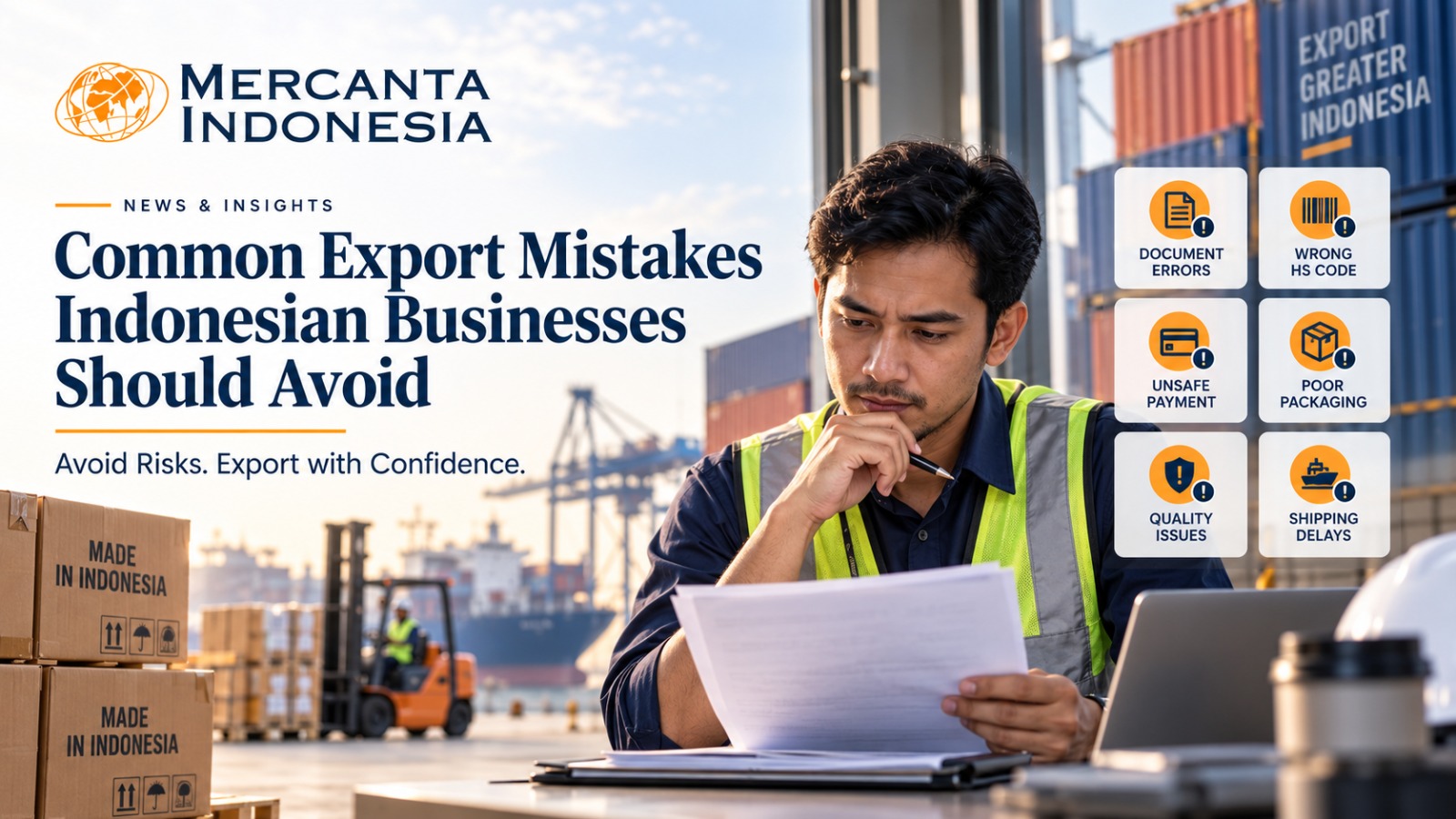
Learn about common export mistakes made by Indonesian businesses, including poor market research, improper buyer verification, incorrect HS codes, pricing errors, and regulatory issues.
Common Export Mistakes Indonesian Businesses Should Avoid
Exporting gives Indonesian businesses the opportunity to reach new customers, increase production, diversify revenue, and introduce local products to international markets.
However, export success requires more than having a good product. Businesses must understand international buyer expectations, product regulations, pricing structures, documentation, payment risks, logistics, and quality standards.
Many export problems are caused by avoidable mistakes made before production or shipment begins. Recognizing these risks early can help Indonesian businesses build more reliable and sustainable international trade relationships.
1. Starting Without Proper Market Research
One of the most common mistakes is attempting to sell a product internationally without understanding the target market.
A product that performs well in Indonesia may not automatically succeed in another country. Differences may exist in: - Consumer preferences - Product sizes - Packaging - Price expectations - Cultural practices - Distribution channels - Competition - Labeling requirements - Import duties - Product regulations
Exporters should determine whether there is actual demand before investing heavily in certification, packaging, inventory, or international promotion.
Questions to answer before entering a market: - Who is the target customer? - What similar products are already available? - What is the average retail and wholesale price? - Which product sizes and specifications are preferred? - What certifications are required? - Which sales and distribution channels are commonly used? - What is the estimated landed cost? - Can the product remain competitive after freight, duties, taxes, and distributor margins?
Market selection should be based on commercial evidence rather than assumptions.
2. Choosing the Wrong Buyer
Receiving an international inquiry can be exciting, especially for a first-time exporter. However, not every inquiry represents a genuine or suitable business opportunity.
Exporters should evaluate prospective buyers before providing confidential information, producing customized samples, extending credit, or accepting unusual payment arrangements.
Basic buyer verification may include: - Registered company name - Business address - Company website - Contact person and position - Business registration - Main products and markets - Import experience - Distribution network - Banking information - Trade references - Expected order volume
Warning signs: Exporters should investigate further when a buyer: - Uses only a free personal email address - Refuses to provide company information - Places an unusually large first order - Accepts prices without negotiation or questions - Requests payment to or from unrelated parties - Proposes complicated financial arrangements - Asks the supplier to pay unexplained fees - Changes shipping or payment instructions frequently - Pressures the supplier to act immediately
A professional exporter should qualify the buyer as carefully as the buyer evaluates the supplier.
3. Offering Products That Are Not Export-Ready
A locally marketable product is not necessarily ready for export.
Export readiness requires consistency in: - Product specifications - Raw materials - Quality - Production capacity - Packaging - Labeling - Shelf life - Testing - Documentation - Delivery performance
Before approaching international buyers, suppliers should prepare: - Company profile - Product catalog - Technical specifications - Minimum order quantity - Production lead time - Export packaging information - Available certifications - Sample policy - Price structure - Product photographs - Contact information
Exporters should avoid promising specifications, volumes, or certifications that they cannot consistently deliver.
4. Using Inaccurate Product Classification
Every traded product must be classified under a Harmonized System or HS code.
The HS code may determine: - Customs duties - Export restrictions - Import restrictions - Required licenses - Product standards - Certificates - Taxes - Trade-agreement eligibility - Customs inspections
Selecting an HS code based only on a similar product or an online search may create problems.
Product classification should consider: - Materials - Composition - Function - Processing level - Packaging - Intended use - Technical characteristics
Incorrect classification may result in customs delays, reassessment of duties, penalties, or rejection of preferential tariffs.
When classification is uncertain, exporters should consult customs professionals or relevant authorities before shipment.
5. Ignoring Destination-Country Regulations
Complying with Indonesian export requirements does not automatically mean that the goods can legally enter another country.
The destination market may impose requirements relating to: - Food safety - Product registration - Health and sanitary standards - Phytosanitary controls - Labeling - Allergens - Chemical substances - Packaging materials - Electrical safety - Sustainability - Timber legality - Traceability - Consumer warnings - Language - Recycling obligations
Exporters and buyers should confirm these requirements before production.
Producing goods before regulatory approval may lead to relabeling costs, rejected shipments, destruction of products, or an inability to sell the goods legally.
6. Quoting an Incomplete Export Price
A factory price is not the same as an export price.
Export pricing may need to include: - Product cost - Export packaging - Inland transportation - Warehouse handling - Documentation - Customs processing - Terminal charges - Inspection - Certification - Bank charges - Freight - Insurance - Commission - Currency risk - Taxes - Contingency - Profit margin
Exporters sometimes quote a low price to attract the buyer and later discover that important costs were excluded.
Unexpected price changes can damage credibility and may cause the buyer to cancel the transaction.
A quotation should state clearly: - Currency - Unit price - Minimum order quantity - Incoterm - Named location or port - Packaging basis - Quotation validity - Payment terms - Production lead time - Included and excluded costs
7. Selecting the Wrong Incoterm
Incoterms determine how transportation costs, customs responsibilities, and shipment risks are divided between the seller and buyer.
Common terms include: - EXW - FCA - FOB - CFR - CIF - CPT - CIP - DAP - DDP
A seller should not accept an Incoterm without understanding its operational and financial consequences.
For example: - Under EXW, the buyer assumes most responsibilities from the seller's premises. - Under FOB, the seller must deliver the goods on board the vessel at the named port. - Under CIF, the seller pays freight and arranges the required insurance, but risk transfers at the origin port once the goods are on board. - Under DDP, the seller assumes extensive responsibility, including import clearance and applicable duties at destination.
Offering DDP without the ability to act as an importer or manage destination-country taxes can create serious problems.
Always include a specific place and rule version, such as: FOB Tanjung Priok Port, Jakarta, Incoterms 2020
8. Accepting Unsafe Payment Terms
Payment risk is one of the most important issues in international trade.
Potential payment methods include: - Advance payment - Deposit with balance before shipment - Deposit with balance after inspection - Documentary collection - Letter of Credit - Open account - Escrow, where appropriate and available
The most suitable method depends on: - Order value - Buyer history - Product customization - Production period - Country risk - Banking costs - Supplier cash-flow requirements - Relationship maturity
A first-time exporter should be cautious about providing substantial credit to an unverified buyer.
Exporters must also confirm bank instructions carefully. Requests to change bank accounts should be verified through a separate and trusted communication channel.
9. Relying Only on Verbal Agreements
Important commercial terms should never depend solely on telephone calls, meetings, or messaging applications.
A written quotation, purchase order, proforma invoice, or sales contract should define: - Product specifications - Quantity - Price - Currency - Payment terms - Production lead time - Incoterm - Delivery schedule - Packaging - Inspection - Required documents - Product acceptance - Claims procedure - Intellectual-property rights - Confidentiality - Dispute resolution
Written agreements reduce misunderstandings and provide evidence of what both parties accepted.
Any later changes should also be confirmed in writing.
10. Using Incomplete or Inconsistent Documents
Export documentation must accurately represent the transaction and shipment.
Common documents may include: - Commercial invoice - Packing list - Export declaration - Bill of Lading or Air Waybill - Certificate of Origin - Insurance certificate - Inspection certificate - Health certificate - Phytosanitary certificate - Fumigation certificate - Certificate of analysis - Product-specific approvals
Common documentation errors include: - Different company names - Inconsistent product descriptions - Incorrect quantities - Different weights - Incorrect HS codes - Incorrect consignee information - Missing signatures - Incorrect ports - Unclear Incoterms - Certificates that do not cover the product
Documents should be reviewed together before submission or shipment.
11. Underestimating Packaging Requirements
Export packaging must protect goods through inland transportation, port handling, international shipping, customs inspection, warehousing, and final delivery.
Packaging should be designed according to: - Product fragility - Weight - Moisture sensitivity - Temperature requirements - Transportation method - Stacking conditions - Transit time - Destination climate - Buyer requirements - Regulatory standards
Poor packaging may result in: - Broken products - Moisture damage - Contamination - Leakage - Crushed cartons - Label damage - Rejected goods - Insurance disputes
Exporters should consider drop tests, stacking tests, moisture protection, pallet requirements, fumigation rules, and container-loading methods where appropriate.
12. Failing to Control Product Quality
A high-quality sample does not guarantee that mass production will meet the same standard.
Exporters should establish quality controls covering: - Incoming raw materials - Production stages - Finished products - Packaging - Labeling - Quantity - Container loading
The product specification should define: - Materials - Dimensions - Weight - Color - Composition - Performance - Acceptable tolerances - Defect classifications - Testing methods - Acceptance criteria
Quality records should be maintained for each batch or production lot where appropriate.
Exporters should welcome reasonable inspections because they help identify problems before the goods reach the destination market.
13. Promising Unrealistic Production Capacity
Exporters may be tempted to accept an order larger than their normal capability.
This can lead to: - Delayed production - Excessive overtime - Uncontrolled subcontracting - Lower product quality - Raw-material shortages - Inconsistent packaging - Missed shipping schedules
Production capacity should be calculated realistically based on: - Available machinery - Workforce - Raw-material supply - Existing orders - Quality-control capacity - Packaging capacity - Seasonal conditions - Maintenance schedules
If subcontracting is required, it should be disclosed and controlled according to the buyer's agreement.
14. Failing to Plan the Logistics Timeline
The production-completion date is not the same as the shipment-departure date.
The exporter must allow time for: - Final inspection - Product testing - Documentation - Export clearance - Inland transportation - Port handling - Container booking - Carrier cut-off - Vessel schedule - Possible transshipment - Destination clearance
Exporters should also understand: - Demurrage - Detention - Storage charges - Container free time - Port congestion - Peak-season capacity - Holiday schedules - Weather disruptions
A realistic timeline should include reasonable contingency rather than depending on the fastest possible schedule.
15. Shipping Without Adequate Insurance
Incoterms do not always require either party to arrange insurance.
When insurance is required or commercially advisable, exporters and buyers should confirm: - Who purchases the policy - Insured value - Covered risks - Exclusions - Coverage period - Claim procedure - Required evidence - Deductible - Geographic coverage
The party arranging insurance should understand whether the coverage is sufficient for the product and transportation risk.
Minimum coverage may not protect against every type of loss or damage.
16. Neglecting Currency Risk
An exporter may quote in United States dollars or another foreign currency while many production costs are paid in Indonesian rupiah.
Exchange-rate movements between quotation, production, payment, and shipment can affect profitability.
Exporters can manage currency exposure by: - Limiting quotation-validity periods - Using appropriate payment schedules - Including a currency-adjustment clause where suitable - Building reasonable contingency into the price - Discussing hedging options with financial institutions - Matching purchase and sales currencies where practical
Currency risk should be considered before a long-term fixed-price agreement is accepted.
17. Failing to Protect Intellectual Property
Export transactions may involve: - Brand names - Logos - Product designs - Packaging artwork - Recipes - Formulations - Molds - Technical drawings - Confidential buyer information
The parties should establish ownership and permitted use clearly.
Suppliers should not use a buyer's trademarks or designs without authorization. Buyers should also respect original Indonesian designs, traditional knowledge, and supplier-owned product developments.
Confidentiality, non-disclosure, design-ownership, and exclusivity provisions may be appropriate depending on the relationship.
18. Depending on a Single Buyer or Market
A large buyer can create rapid growth, but excessive dependence may expose the exporter to: - Sudden order reductions - Aggressive price pressure - Payment delays - Regulatory changes - Currency fluctuations - Political risk - Distribution changes - Contract termination
Exporters should gradually diversify across: - Buyers - Countries - Product categories - Distribution channels - Payment structures
Diversification should be managed carefully so that the business does not expand beyond its operational capacity.
19. Focusing Only on the First Shipment
The objective of exporting should not be limited to completing one order.
Sustainable export growth depends on: - Consistent product quality - On-time delivery - Accurate documentation - Responsive communication - Efficient problem-solving - Product development - Market adaptation - Buyer retention - Repeat orders
After each shipment, the exporter should review: - What worked well? - What caused delays? - Were there quality complaints? - Were all documents accurate? - Did actual costs match the quotation? - Was the shipment profitable? - What should be improved before the next order?
Every shipment should strengthen the company's export system.
Export Readiness Checklist
Before accepting an international order, confirm that:
Market: - The target customer and demand are understood - Competition has been evaluated - The product is suitable for the market - Landed pricing is competitive
Buyer: - Company information has been reviewed - The buyer's requirements are clear - Payment risk has been assessed - The decision-maker is identified
Product: - Specifications are documented - Samples are approved - Production capacity is available - Raw materials are secured - Quality controls are established
Compliance: - The HS code has been reviewed - Export requirements are understood - Destination-country regulations are confirmed - Required certificates are available - Labeling and packaging comply
Commercial terms: - Price and currency are confirmed - Incoterm and named place are stated - Payment terms are documented - Production and delivery schedules are realistic - Claims and dispute procedures are agreed
Shipment: - Freight is booked - Insurance responsibility is clear - Inspection is completed - Documents are accurate and consistent - Customs and delivery arrangements are confirmed
Building a Stronger Export Business
Export success is the result of preparation, discipline, and continuous improvement.
Indonesian businesses can reduce export risk by: - Researching markets carefully - Qualifying buyers - Preparing export-ready products - Calculating all costs - Confirming regulations - Using clear contracts - Controlling quality - Managing documentation - Selecting appropriate payment terms - Reviewing performance after every shipment
The goal is not simply to sell products overseas. It is to build a reliable export operation that international buyers can trust.
How Mercanta Indonesia Can Help
Mercanta Indonesia supports Indonesian suppliers and international buyers through a structured sourcing and trade-facilitation process.
Depending on the agreed scope, our role can include: - Product and market coordination - Buyer and supplier communication - Product-information preparation - Quotations and samples - Commercial-term discussions - Export-document coordination - Inspection and testing coordination - Freight communication - Confidential business introductions - Transaction monitoring
By identifying risks early and creating clearer communication between parties, Mercanta Indonesia helps support more organized and sustainable international transactions.
Preparing your business for global markets or looking for Indonesian products? Contact Mercanta Indonesia to begin a structured trade discussion.
Disclaimer: This article provides general information and does not constitute legal, financial, tax, customs, insurance, certification, or regulatory advice. Businesses should consult qualified professionals and verify current requirements for each product, country, and transaction.