Finding Reliable Suppliers in Indonesia: A Buyer’s Guide
A comprehensive guide for international buyers on evaluating Indonesian suppliers—covering legal verification, production capacity, quality control, certifications, and risk management.
Indonesia offers international buyers access to a diverse range of products, including coffee, spices, coconut derivatives, processed food, seafood, furniture, textiles, handicrafts, natural ingredients, building materials, and industrial components.
Finding a supplier is relatively easy. Finding a supplier that is legally established, operationally capable, quality-focused, and commercially reliable requires a more structured process.
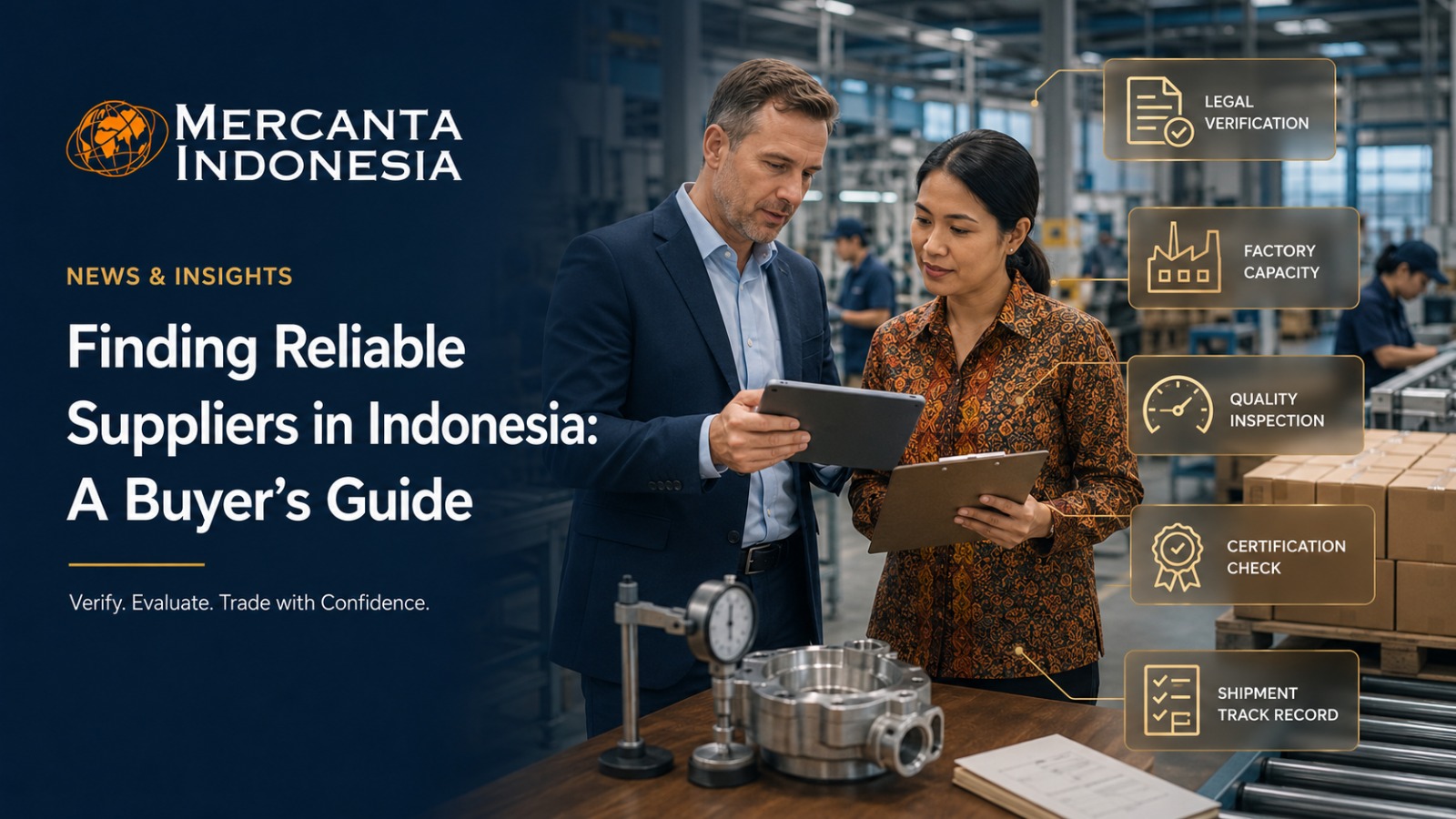
A professional supplier evaluation should examine five essential areas:
1. Legal status 2. Production capacity 3. Quality-management capability 4. Certifications and compliance 5. Business track record
This guide explains how international buyers can evaluate Indonesian suppliers while reducing sourcing, quality, payment, and delivery risks.
Why Supplier Verification Matters
A competitive quotation does not automatically mean that a supplier is capable of fulfilling an international order.
Without proper verification, buyers may encounter:
• Inconsistent product quality • Production delays • Inaccurate company information • Insufficient production capacity • Missing licenses or certificates • Subcontracting without approval • Products that fail destination-market requirements • Unexpected logistics costs • Communication problems • Payment disputes • Non-delivery of goods
Supplier verification does not eliminate every risk, but it helps buyers make informed decisions before paying deposits, approving samples, or committing to large orders.
The depth of verification should reflect the value, complexity, and risk level of the transaction.
1. Verify the Supplier’s Legal Identity
The first step is confirming that the supplier is a legitimate business entity.
Buyers should request the supplier’s complete legal information, including:
• Registered company name • Business address • Business Identification Number or NIB • Tax identification information • Company establishment documents • Relevant business classifications • Name and position of the authorized representative • Business bank-account details • Product-specific licenses, where required
The name appearing on quotations, invoices, contracts, certificates, and bank accounts should be consistent with the registered company identity.
Questions buyers should ask
• Is the supplier a manufacturer, trading company, exporter, cooperative, or individual producer? • Is the company legally authorized to conduct the relevant business activity? • Who is authorized to sign contracts? • Does the company operate from the address it provides? • Does the beneficiary name on the bank account match the contracting party? • Will another company issue the export documents? • Is the supplier working through an affiliated exporter or logistics partner?
A difference between the supplier, manufacturer, exporter, and payment recipient is not automatically a problem. However, the relationship between these parties must be explained and documented clearly.
Warning signs
Buyers should investigate further when:
• The supplier refuses to disclose its legal company name • Documents contain inconsistent company names or addresses • Payment is requested to an unrelated personal account • The sales representative cannot explain the company structure • The supplier claims to own a factory but cannot provide basic operational evidence • Licenses appear altered, incomplete, or expired • The contracting party is different from the party receiving payment without a clear agreement
Legal documents should be verified through appropriate official channels or qualified local professionals rather than accepted solely as scanned copies.
2. Understand the Supplier’s Actual Role
Not every supplier is a manufacturer. Indonesian products may be offered by:
• Factories • Processors • Farmer groups • Cooperatives • Artisan workshops • Exporters • Trading companies • Aggregators • Sourcing agents • Distributors
Each model can be legitimate and valuable.
A trading company, for example, may provide stronger export documentation, product consolidation, quality coordination, and communication than an individual producer. A manufacturer may offer better production control but have limited export experience.
The important issue is transparency.
Buyers should understand:
• Who manufactures the product? • Who owns the raw materials? • Who controls quality? • Who prepares the export documents? • Who is responsible for packaging? • Who receives payment? • Who is contractually responsible if the goods fail to meet specifications?
A reliable supplier should explain its role accurately rather than presenting itself as something it is not.
3. Assess Production Capacity
Production capacity should be evaluated before agreeing to order quantities and delivery schedules.
Buyers should request information about:
• Monthly production capacity • Current production commitments • Available capacity • Number of production lines • Workforce • Machinery and equipment • Raw-material sources • Production lead time • Seasonal limitations • Minimum order quantity • Maximum practical order volume • Ability to increase production
A supplier’s stated maximum capacity may not equal its available capacity. A factory capable of producing 100,000 units per month may already have commitments for 80,000 units.
The buyer should therefore ask about capacity available for the proposed order during the required delivery period.
Capacity should match the order
Large capacity is not always better.
A large factory may not accept small orders or extensive customization. A smaller producer may provide greater flexibility but may struggle with high-volume or short-deadline orders.
The right supplier is one whose production model matches the buyer’s:
• Order volume • Quality requirements • Delivery schedule • Customization needs • Growth expectations
Ways to verify capacity
Depending on the transaction, buyers may use:
• Factory photographs and videos • Live video inspections • Production records • Machinery lists • Workforce information • Raw-material purchase records • Site visits • Independent factory audits • Trial orders • Production monitoring
A supplier should be able to explain each production stage and identify potential bottlenecks.
4. Evaluate Raw-Material Supply
A supplier cannot maintain production without reliable access to raw materials.
Buyers should determine:
• Where raw materials come from • Whether the supplier uses one or multiple sources • Whether supply is seasonal • How prices fluctuate • What traceability records are maintained • How incoming materials are inspected • Whether substitute materials may be used • How supply interruptions are managed
This is particularly important for agricultural products, seafood, natural fibers, timber, spices, coffee, coconut products, and handmade goods.
Natural materials may vary in color, size, texture, moisture, and composition. Acceptable tolerances should be defined before production begins.
For regulated or sustainability-sensitive products, buyers may also need evidence of legal, ethical, or traceable sourcing.
5. Review Quality-Control Systems
Product quality should be based on measurable standards rather than subjective descriptions such as “high quality” or “export quality.”
The buyer and supplier should agree on:
• Materials • Dimensions • Weight • Color • Performance • Composition • Moisture content • Packaging • Labeling • Workmanship • Testing methods • Acceptable tolerances • Defect classifications • Inspection procedures • Acceptance criteria
These requirements should be recorded in a product specification sheet, technical drawing, approved sample, purchase order, or sales contract.
Questions about quality control
Buyers should ask:
• How are incoming materials inspected? • At which stages is quality checked? • Who is responsible for quality approval? • Are inspection results documented? • How are defective products separated? • How are measuring instruments calibrated? • Is there a batch or lot-traceability system? • How are buyer complaints investigated? • What corrective actions are taken? • Can the supplier provide recent quality reports?
A supplier that can explain its quality-control process clearly is generally more dependable than one that only promises that the product will be “good.”
6. Request and Evaluate Samples
Samples help buyers evaluate the supplier’s materials, workmanship, specifications, packaging, and ability to follow instructions.
The sample process should establish:
• Sample specification • Sample price • Courier cost • Completion date • Customization requirements • Approval procedure • Ownership of designs or molds • Required revisions • Relationship between the sample and mass production
An approved sample should be retained by both parties when practical. It can serve as a reference during production and inspection.
However, a good sample does not guarantee consistent mass production. Buyers should also evaluate the supplier’s process controls and conduct inspections during or before shipment.
7. Check Certifications Carefully
Certifications can demonstrate compliance with specific systems, products, materials, or market requirements. However, the existence of a certificate should never be accepted without reviewing its scope.
Depending on the product, buyers may request:
• Quality-management certificates • Food-safety certifications • Halal certification • Organic certification • Sustainability certification • Timber-legality documentation • Social-compliance audits • Health or sanitary certificates • Certificates of analysis • Phytosanitary certificates • Product testing reports • Technical-compliance documents • Certificates of Origin
How to review a certificate
Check:
• Legal name of the certified company • Address of the certified facility • Certificate number • Issuing organization • Validity period • Product or activity covered • Applicable standard • Production location • Accreditation status, where relevant • Online verification options
A valid certificate for one facility or product does not automatically cover every product offered by the supplier.
Buyers must also distinguish between:
• Company-level certification • Factory certification • Product certification • Batch-specific testing • Shipment-specific documentation
The buyer remains responsible for confirming which certifications are required in the destination country.
8. Review Laboratory and Product Testing
Testing may be required for food, cosmetics, chemicals, textiles, furniture, construction products, electrical goods, children’s products, and other regulated categories.
A laboratory report should be reviewed for:
• Product name • Sample identification • Test date • Test method • Result • Applicable standard • Laboratory identity • Accreditation, where required • Name of the company submitting the sample • Connection between the tested sample and the goods being purchased
An old laboratory result or a result issued for a different product may not be sufficient.
For higher-risk transactions, buyers may arrange independent sampling and testing rather than relying entirely on documents supplied by the seller.
9. Investigate the Supplier’s Track Record
A supplier’s history can provide insight into its operational reliability.
Buyers may request:
• Years in business • Main product categories • Export experience • Principal export markets • Customer references • Recent shipment records • Project examples • Repeat-order history • Trade-fair participation • Complaint-handling examples • Litigation or dispute information, where legally available
Customer names may be confidential. A supplier should not be expected to disclose sensitive commercial relationships without permission.
Alternative evidence may include:
• Anonymized case studies • Redacted shipping documents • General market references • Product photographs • Inspection reports • Evidence of repeat production • Permission-based buyer references
Track-record information should be verified when the order value or risk justifies it.
10. Assess Communication and Responsiveness
Communication quality is often an early indicator of how a supplier will handle production problems.
A reliable supplier should:
• Respond within a reasonable time • Answer questions directly • Confirm specifications in writing • Explain limitations honestly • Provide realistic production schedules • Report delays promptly • Keep commercial information organized • Identify the person responsible for each issue • Maintain consistent information across documents
Frequent changes in price, specifications, company details, or delivery commitments without clear explanations may indicate weak internal coordination.
Buyers should also determine whether the supplier has staff capable of communicating in the required language and time zone.
11. Conduct a Factory Audit or Site Visit
For significant, recurring, customized, or high-risk orders, a factory audit can provide valuable information.
An audit may review:
• Legal identity • Facility ownership or tenancy • Production equipment • Workforce • Production flow • Quality controls • Storage conditions • Raw-material handling • Finished-goods handling • Traceability • Safety procedures • Social and environmental practices • Subcontracting • Production records
If an in-person visit is not practical, buyers can arrange:
• Live video tours • Remote audits • Independent third-party inspections • Local sourcing-partner visits • Time-stamped photographs and videos
A site visit should verify actual capabilities, not merely create marketing content.
12. Identify Undisclosed Subcontracting
Some suppliers outsource part or all of production. Subcontracting is not always negative, but it must be controlled.
Buyers should ask:
• Which production stages are performed internally? • Which activities are subcontracted? • Who approves subcontractors? • How is subcontracted quality controlled? • Do the same standards and certifications apply? • Can production be moved without buyer approval?
Undisclosed subcontracting can create quality, traceability, intellectual-property, labor, and regulatory risks.
The sales contract should state whether subcontracting is permitted and under what conditions.
13. Use a Trial Order
A trial order allows the buyer to evaluate the supplier under real commercial conditions before increasing volume.
It can reveal:
• Actual production lead time • Communication quality • Specification control • Packaging performance • Documentation accuracy • Inspection results • Shipping coordination • Response to problems
A trial order should still use clear specifications, written commercial terms, inspection procedures, and suitable payment protection.
A small first order is not risk-free, but it limits exposure while the business relationship is being tested.
14. Establish Safe Payment Terms
Payment terms should balance the supplier’s need for production funding with the buyer’s need for protection.
Possible methods include:
• Deposit with balance before shipment • Deposit with balance after inspection • Documentary collection • Letter of Credit • Escrow, where suitable and available • Open-account terms for established relationships
The appropriate method depends on:
• Order value • Product customization • Production cycle • Relationship history • Supplier financial strength • Buyer creditworthiness • Country risk • Banking costs • Available trade-finance instruments
Buyers should verify bank details independently before transferring funds, particularly after receiving any request to change the beneficiary or account number.
Payment terms should be stated clearly in the contract and commercial documents.
15. Arrange Independent Inspection
An inspection can be conducted at different stages.
Pre-production inspection Confirms raw materials, specifications, and production readiness.
During-production inspection Reviews quality and progress while production is underway.
Pre-shipment inspection Checks finished goods, quantity, workmanship, packaging, labeling, and selected functional requirements before shipment.
Container-loading supervision Confirms that approved goods are loaded correctly and records container and seal information.
Inspection does not transfer responsibility from the supplier. It provides additional evidence that the goods meet agreed requirements at the time of inspection.
Common Supplier Red Flags
Buyers should investigate further when a supplier:
• Offers a price far below the normal market level • Refuses a live video call or facility visit • Provides inconsistent company information • Uses documents belonging to another company without explanation • Requests payment to an unrelated personal account • Cannot explain its production process • Claims unlimited capacity • Guarantees unrealistic lead times • Refuses to provide samples • Pressures the buyer to transfer funds immediately • Frequently changes bank details • Avoids written specifications • Rejects reasonable inspection requests • Cannot verify certifications • Uses copied product photographs • Promises compliance without supporting evidence • Changes materials without buyer approval
One warning sign does not automatically prove misconduct. Several unresolved inconsistencies, however, should be treated seriously.
A Practical Supplier Verification Checklist
Before confirming an order, buyers should verify:
Legal and commercial
• Registered company identity • Business address • Authorized signatory • Bank-account ownership • Contracting and exporting parties • Relevant licenses
Production
• Manufacturer or trader status • Available capacity • Production lead time • Machinery and workforce • Raw-material supply • Subcontracting arrangements
Quality
• Written product specifications • Approved sample • Quality-control procedures • Testing requirements • Inspection plan • Defect and claims procedures
Compliance
• Required certifications • Certificate scope and validity • Destination-country regulations • Labeling requirements • Traceability documentation • Export and import restrictions
Track record
• Years in operation • Export experience • Relevant project history • Buyer references where available • Evidence of previous shipments • Complaint-handling process
Transaction controls
• Written quotation • Payment terms • Incoterm and named location • Delivery schedule • Required shipping documents • Insurance responsibility • Dispute-resolution provisions
Building a Reliable Supplier Relationship
Supplier verification should not be treated as a one-time activity.
Even after successful initial orders, buyers should continue monitoring:
• Product quality • On-time delivery • Capacity changes • Certification validity • Regulatory compliance • Communication performance • Corrective actions • Financial and operational changes
A strong supplier relationship is built through clear expectations, fair commercial terms, reliable performance, and continuous communication.
Buyers should also act responsibly by providing accurate forecasts, timely approvals, clear specifications, and payments according to the agreement.
Reliability must work in both directions.
How Mercanta Indonesia Can Help
Mercanta Indonesia helps international buyers identify and evaluate sourcing opportunities in Indonesia while protecting legitimate commercial interests and confidential supplier information.
Depending on the agreed scope, our role can include:
• Understanding buyer requirements • Identifying potential suppliers • Coordinating company and product information • Supporting supplier-document reviews • Arranging samples • Coordinating factory visits or remote assessments • Supporting inspection and testing arrangements • Facilitating quotations and commercial discussions • Coordinating export documentation • Supporting logistics communication • Monitoring key transaction stages
Mercanta Indonesia does not replace legal counsel, certification bodies, laboratories, customs professionals, or independent inspection companies. We help coordinate the relevant parties and information so buyers can make better-informed sourcing decisions.
The objective is not simply to find a supplier. It is to help create a transparent, structured, and sustainable supply relationship.
Looking for reliable products and supply partners in Indonesia? Contact Mercanta Indonesia to begin a structured sourcing and supplier-evaluation process.
Disclaimer: This article provides general information and does not constitute legal, financial, customs, regulatory, certification, or professional due-diligence advice. Verification requirements should be adapted to the product, order value, destination market, and risks of each transaction.